
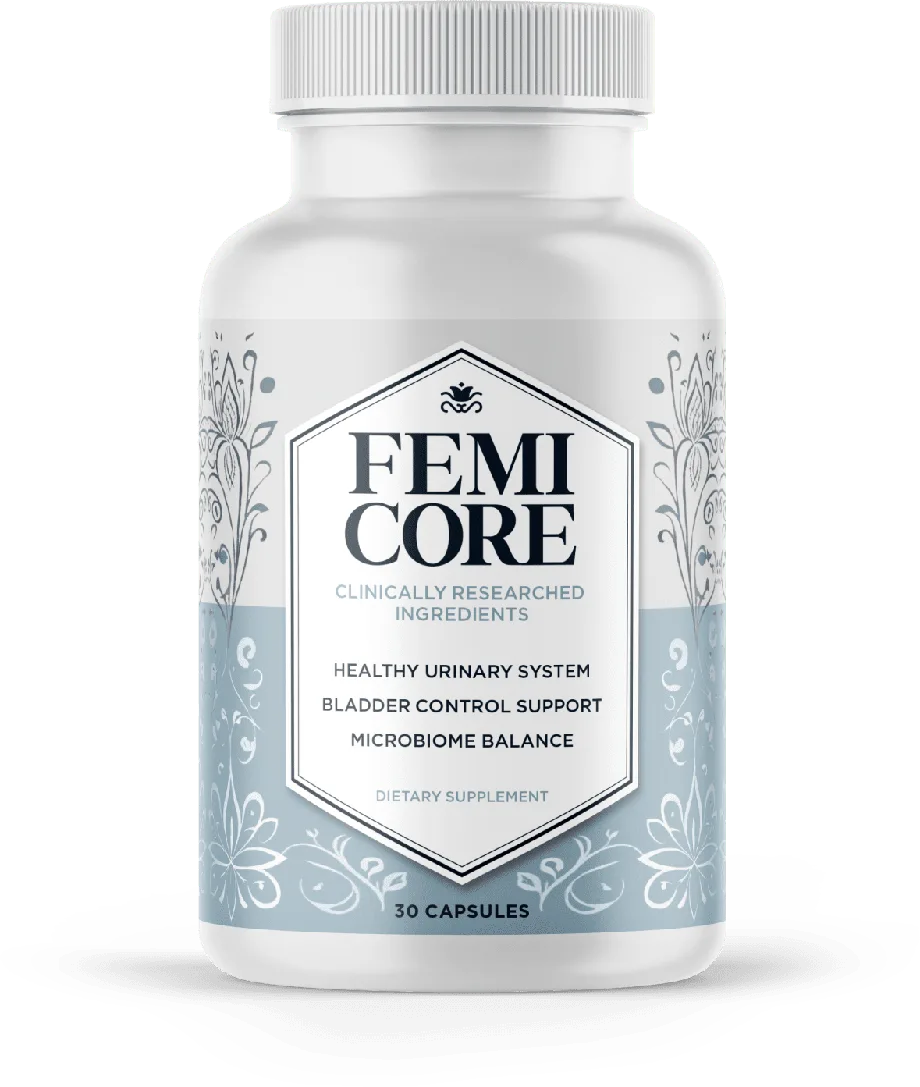
FemiCore at a glance: what the label confirms
FemiCore is marketed for women’s urinary-system, bladder-control and microbiome support. The uploaded product label identifies one capsule as a serving, with thirty servings per container. Its botanical group totals 350 mg; its probiotic group totals 50 mg. The two blend totals are distinct from individually quantified ingredient doses.
The seller describes a bacteria-oriented theory for supporting bladder comfort. Those statements explain marketing intent, not a clinical finding that the finished product prevents infections or reliably changes incontinence symptoms. Research on cranberry and selected probiotics can provide context, but cannot substitute for trials of the exact combination.
The published seller offer displays two, three and six-bottle packages, a 60-day guarantee and three digital guides with its six-bottle package. These commercial details are separate from the scientific question of how well the formula works.
What is FemiCore?
The product is a 30-capsule dietary supplement distributed under the FemiCore brand. It is not a prescription bladder medication, an antibiotic or a treatment for a diagnosed urinary infection. The seller highlights healthy urinary function, bladder control and microbiome balance in its promotional presentation.
The package says “clinically researched ingredients” and includes facility/manufacturing marks. A claim about ingredients or a facility does not demonstrate that this particular finished blend has been proven effective in a well-controlled human study.
We examine the labeled formula, relevant independent studies and buyer terms separately. That helps distinguish product convenience and advertised features from clinical conclusions.
Herbal and probiotic formula: what is listed
The 350 mg herbal blend contains mimosa pudica seed, cranberry extract standardized to 30% proanthocyanidins, bearberry leaf and berberine hydrochloride extract. Their exact individual amounts are not printed. The 50 mg probiotic blend lists L. crispatus LCr86, L. acidophilus LA88, L. plantarum N13, L. gasseri LG08 and L. casei LC16.
The declared probiotic weight is not a CFU count and does not prove a guaranteed number of viable organisms. Research about a species or another strain should not automatically be assigned to one of these exact named strains.
| Declared group | Total per capsule | Ingredients listed on uploaded label |
|---|---|---|
| Herbal Blend | 350 mg | Mimosa pudica seed extract; Cranberry extract (Vaccinium macrocarpon berry, standardized to 30% proanthocyanidins); Bearberry leaf (Arctostaphylos uva-ursi); Granular berberine hydrochloride extract 8% (bark/root) |
| Probiotic Blend | 50 mg | Lactobacillus crispatus LCr86; Lactobacillus acidophilus LA88; Lactobacillus plantarum N13; Lactobacillus gasseri LG08; Lactobacillus casei LC16 |
Individual milligram allocations are not listed. The probiotic group provides no CFU count. Other ingredients: gelatin, brown rice flour, magnesium stearate, olive oil and silicon dioxide.
See all FemiCore ingredients and individual research →
How does the seller say FemiCore works?
The vendor says it aims to support bladder control by addressing urinary microbiome balance through a combined botanical and probiotic formula. It also markets support for urinary wellness and regular daily use.
NCCIH describes evidence that some cranberry products can help lower recurrent UTI risk in certain women, while emphasizing that cranberry cannot treat an existing infection. Reviews of probiotics for UTI prevention remain mixed and depend on the product, route and outcome.
None of those ingredient findings establishes this particular product’s impact on bladder control, muscle contractions, infection risk or microbial colonization. A reliable product-level conclusion would require an appropriately designed study of FemiCore itself.
Explore the seller mechanism and research →
Benefits and practical features
Seller-promoted benefits include healthy urinary-system support, bladder comfort and microbiome balance. Practical features apparent from the product information include one capsule per day, thirty capsules per bottle and packaging choices ranging from two to six bottles.
For some buyers, a familiar ingredient such as cranberry or an explicitly named probiotic strain may be useful for further research. However, the disclosed label alone is not enough to calculate individual cranberry PAC milligrams or compare probiotic live counts with an independent study.
The most relevant question is whether a marketed benefit matches a meaningful measured outcome for the finished formula—not whether the advertising can describe an interesting biological pathway.
Safety, side effects and dosage
The uploaded FemiCore label instructs adults to take one capsule daily with 6–8 ounces of water and consult a clinician when needed. It specifically warns against use above the suggested dose and recommends medical consultation for pregnancy, nursing and known conditions.
Berberine can interact with medications and raises pregnancy or breastfeeding concerns according to NCCIH. Other botanicals and probiotics also deserve an individual review. People who take prescription drugs or have complicated health histories should show the actual panel to a qualified clinician or pharmacist.
A persistent or painful urinary problem is a medical question, not a checkout question. Cranberry-based products are not an alternative to care for an existing infection. Seek medical assessment for worrying symptoms.
Pricing, refund terms and bonus eligibility
The published seller offers currently describe two bottles at $79 each ($158 subtotal), three at $69 each ($207) and six at $49 each ($294). The two-bottle offer includes a reported $9.99 US shipping charge, while larger bundles advertise free US shipping. Each bottle contains about one month of labeled servings.
The six-bottle promotion advertises three free digital guides about relationships, digestion and lower-body movement. The seller advertises a 60-day money-back policy and describes a return process requiring the bottles and packing slip. The buyer must review the written current terms that apply to the order.
See the actual 2-, 3- and 6-bottle package images
The three promotional images were supplied for this project. These seller-reported USD prices are dated November 7, 2026; verify final totals, taxes, shipping and terms at checkout.

2 Bottles
Approximately 60 days
$79per bottle
Seller-reported subtotal: $158

3 Bottles
Approximately 90 days
$69per bottle
Seller-reported subtotal: $207

6 Bottles
Approximately 180 days
$49per bottle
Seller-reported subtotal: $294
The six-bottle offer advertises three free digital ebooks. We do not assume those extras apply to the 2- or 3-bottle options. View the bonus guide images →
Pros and Cons: product-focused assessment
Strengths include the clear one-capsule routine, identifiable herb and strain names, cranberry research context, and a dedicated product packaging and buying information trail. The product is marketed toward a specific area of women’s urinary wellness rather than a broad undefined wellness category.
Considerations include blend quantities that do not reveal the dose of each ingredient, no labeled live CFU count, medication interactions for certain botanical constituents and the need for separate clinical evidence to substantiate outcomes. These are research questions, not an assumption that the supplement is ineffective.
Pros
- Marketed for bladder and urinary wellness support
- Convenient once-daily capsule format
- Names four botanicals and five probiotic strains
- Cranberry offers a relevant ingredient research topic
- Clear 30-capsule supply information
Cons and considerations
- Individual herb amounts and probiotic CFUs not printed
- Berberine interactions and special-population cautions
- Product-level efficacy cannot be inferred from ingredient research
What evidence would improve this review?
A controlled published trial of the finished supplement with reported symptom measures, adverse events and meaningful comparisons would improve confidence. Transparent doses, probiotic CFUs through shelf life and accessible manufacturing test information would also strengthen the evidence base.
If a seller supplies updated label material or research, Health The News can revisit the page with the specific citation and revision date. Promotional testimonials or a badge about facilities are not substitutes for testable product outcomes.
Frequently asked questions
What is FemiCore?
A once-daily capsule supplement marketed for women’s bladder, urinary and microbiome support. These are seller positioning statements, not a diagnosis or treatment claim.
What is in FemiCore?
The supplied label lists a 350 mg herbal blend of mimosa pudica seed, cranberry, bearberry and berberine, plus a 50 mg probiotic blend of five named Lactobacillus strains.
How many capsules should I take?
The supplied label recommends one capsule per day with 6–8 oz of water, or as directed by a healthcare professional.
How many capsules are in a bottle?
The uploaded label declares 30 capsules and 30 servings per bottle.
What does FemiCore cost?
Advertised bundles list 2 bottles at $79 each, 3 at $69 each and 6 at $49 each; the actual seller checkout controls current final totals.
Which package includes the three bonus guides?
The reviewed seller presentation advertises the three digital bonus guides with the six-bottle promotion.
Is FemiCore FDA approved?
The uploaded packaging states it is manufactured in an FDA-registered facility. The FDA does not approve dietary supplements for safety or effectiveness before sale, so facility registration must not be interpreted as product approval.
Is FemiCore safe for pregnancy or breastfeeding?
The label advises pregnant or nursing individuals to speak to a physician. Berberine specifically has pregnancy and breastfeeding cautions; ask a clinician before using the product.
Can FemiCore treat a UTI?
No treatment claim is established. Urinary pain, fever, blood in urine or suspected UTI requires appropriate medical evaluation; cranberry research is not a substitute for treatment.
What is the refund window?
The seller advertises a 60-day money-back guarantee and says returns may require sending all bottles and the packing slip. Check current written terms at checkout.
Can the label confirm probiotic potency?
It identifies a 50 mg probiotic blend and five strains, but does not print individual amounts or live CFU counts.
References & research standards
Seller statements are distinguished from the supplied label and independently published research. External scientific sources do not endorse FemiCore.
- FemiCore seller presentation — ingredients, bonuses, FAQ and guarantee
- NIH NCCIH: Cranberry usefulness and safety
- NIH NCCIH: Probiotics usefulness and safety
- NIH NCCIH: Berberine safety and interaction questions
- FDA: Questions and Answers on Dietary Supplements
- PubMed: Overview of non-antibiotic interventions for recurrent UTIs